va.gov
VA Health Questionnaires
Healthcare experience — executive case study
Problem
Veterans and care teams were spending valuable appointment time collecting, repeating, and transferring health information.
Veterans lacked a consistent way to easily share and update their current health status, medical history, reason for visit, and personal priorities before an appointment. Information was often collected through paper, iPads, or verbal conversations and was not consistently carried forward across visits, facilities, or providers.
For care teams, this meant spending time on data entry, clinical reminders, medication history, and relaying information rather than focusing on the Veteran’s treatment plan. Clinical Reminders alone were estimated at 15–20 minutes during a visit and were identified as a significant nursing complaint.
The underlying problem wasn’t simply forms—it was the broken handoff of information between Veteran and care team.
Research insight
Veterans weren’t opposed to providing information. They wanted to know that it would actually improve their care.
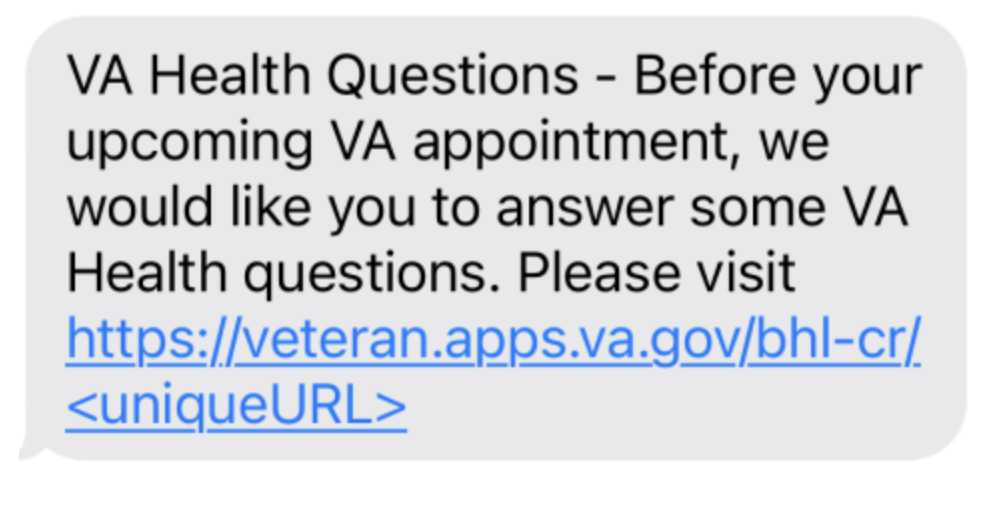
Research showed that Veterans were already familiar with digital pre-visit experiences from civilian providers and preferred completing information before their appointment, using their own devices and in a comfortable environment. They wanted reminders and the ability to review and update information rather than repeatedly provide their entire history.
The biggest pain point was identified as the handoff of information, not completing the questionnaire itself. Veterans questioned the value of providing information when they could not tell whether their care team had seen or used it.
This reframed the opportunity: don’t just digitize the form. Make Veteran-provided information useful to the care team.
Opportunity
Create a seamless pre-visit experience that turns Veteran-provided information into actionable clinical context.
The experience could allow Veterans to:
The Visit Intro concept brought this strategy to life through Reason for Visit, Health Concerns/Important Information, Questions for the Visit, and Patient-Generated Data.
Outcomes / OKRs
Objective / job to be done. When going to a healthcare visit, I want to share my current health status and medical history so that my information can influence and be used to create my treatment plan across the continuum of care.
| North star | How success is measured |
|---|---|
| Optimize care | Increase the number of Veterans whose pre-visit information is leveraged during their care visits |
| Save time | Increase time focused on health outcomes while decreasing time spent on data entry |
Personal experience
Collaboration
Seamless journey
Executive takeaway
The opportunity was to move the VA healthcare experience from collecting information during the visit to using Veteran-provided information to make the visit more focused, efficient, and patient-centered.