{{ kicker }}
{{ title }}
A migration stalled for years
MD Live’s transition to the Evernorth Health Services brand is essential to simplifying how members, consumers and clients understand Evernorth’s full portfolio, and how they experience consistent delivery of care. Yet execution had stalled for multiple years due to cost, client readiness and capacity.
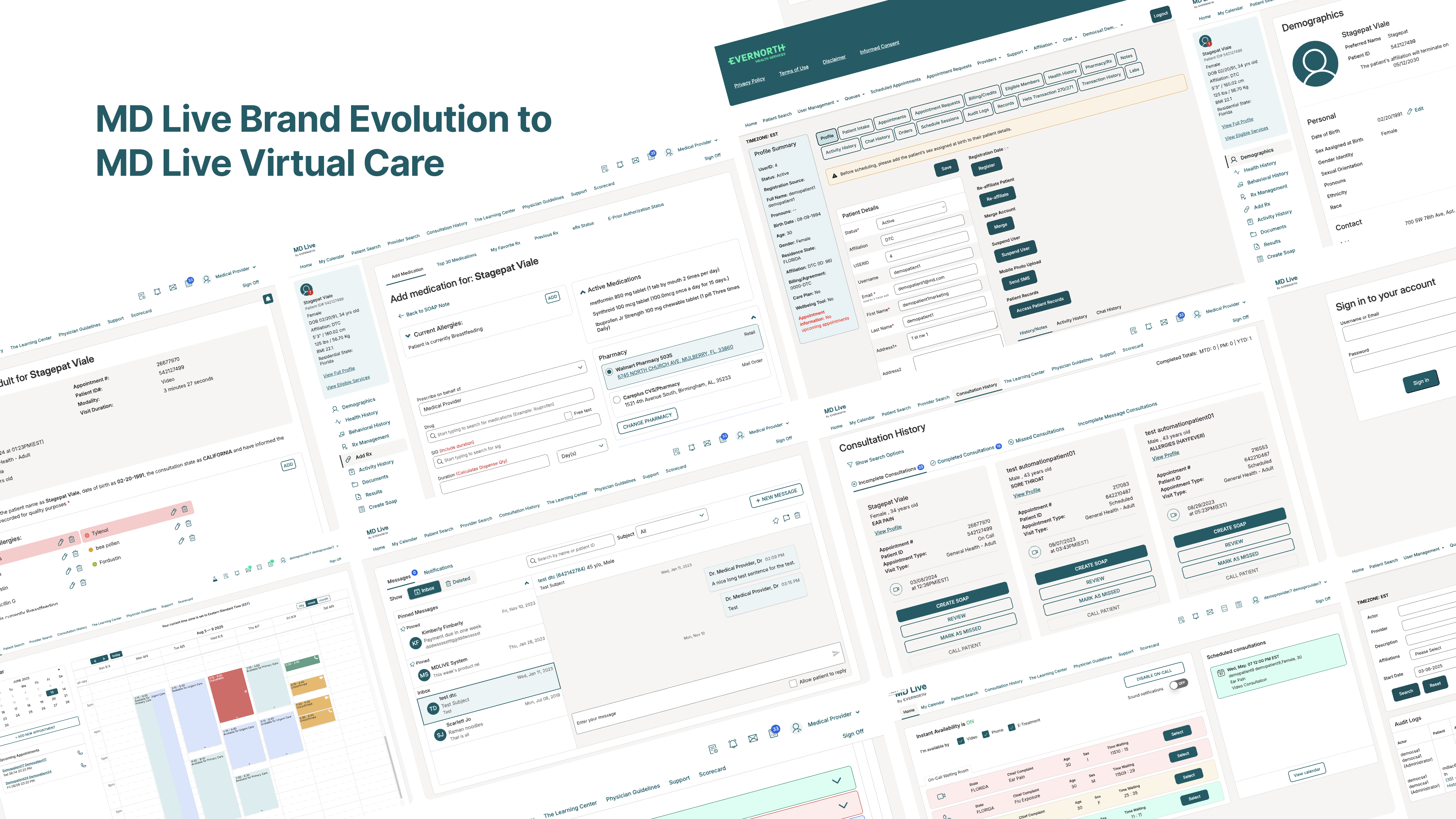
From a one-time rebrand
to platform acceleration
What it means
After multi-year planning and de-prioritization due to limited funding, the team reimagined how to deliver the Evernorth brand migration — beyond a surface-level, temporary rebrand that would require repeated investment.
How it’s done
By leveraging AI in place of traditional development cycles, we achieved the brand outcome in days rather than quarters, and expanded scope to deliver a full token-based design system and modern component library.
Why it matters
This approach avoids incremental spend while establishing a faster, more scalable development model that will materially reduce future costs and accelerate speed-to-market.
The brand outcome at a fraction of the cost
$1.3M
2026 est. cost savings
The traditional product development model required a $1.6M investment for brand migration, exceeding available budget — over 80% of the planned approach was unfunded.
90%+
Design-to-code time cut
Execution timelines compressed from quarters to weeks, with 95% output accuracy achieved in a real staging environment using code connected Figma > Storybook, agentic agents and skills.
3
Resources, not 15–20
AI-driven automation replaced product, engineering and QA-heavy workflows, enabling brand updates with existing team capacity.
What changed — and why we didn’t stop there
Initial plan
A logo and name swap and visual rebrand, delivered by updating the style sheet to mimic the Leaf design system.
What changed
AI-accelerated workflows updated the MD Live Virtual Care name and logos and adopted Leaf design tokens across the current code base and component library — improving brand alignment, consistency and accessibility, ready to go live in weeks.
Why stop there
Speed of execution created capacity to go beyond rebranding. We expanded scope to modernize the patient architecture with a micro-frontend, React Native architecture that decouples UI from backend services. Shared, accessible components improve usability and delivery speed, and product, design and engineering build on one connected technology.
Business impact
New features can be designed and released in days, not quarters, aligned to an empowered team model — a scalable foundation for continuous innovation rather than one-time change.